S
Service
We put the people we work with and for ahead of ourselves. On every job there’s a client, a crew and trade partners counting on us — service means asking what they need right now, especially when it isn’t the easy choice.
I grew up on jobsites. Construction was never something I fell into or decided to try later — I always knew I wanted to build. What I couldn’t have told you was exactly what that would eventually look like.
Over the years I’ve gotten to see the industry from a lot of different angles. I’ve worked in residential new construction and for production home builders. I flipped houses in Philadelphia. I worked for a large heavy civil contractor.
I’ve operated equipment. Worked as an HVAC helper, a plumber’s helper and a mason’s helper. I’ve done just about every form of residential carpentry. I have a CDL, and I’m still a licensed well driller in New Jersey — not much call for that in Snyder County, but it tells you how far around this industry I’ve been.
Basically, I’ve spent most of my life figuring out how things get built. And just as importantly, I’ve spent a lot of time seeing what happens when they aren’t built well.
Funny enough, after all those years around construction, I wasn’t trying to start a construction company.
I’d owned businesses before. At that point in my life I wasn’t looking for another one. I was focused on my marriage, on being a father, and on my faith.
Then a friend of a friend called. They wanted to convert the back of their house into an Airbnb and had heard that I had construction experience.
So I took the project.
It went well.
That led to another opportunity. Then another.
And at some point I looked around and realized I had a construction company.
There wasn’t much of a grand opening.
I don’t think that was an accident. I didn’t build this — it was handed to me. What I’ve done since is try to be a good steward of it.
My wife and I shared one car when I started the company. A 2008 sedan. That was also the company truck.
I’d drive around with tools stuffed in the trunk and back seat, a car seat in there with them, and 2x4s sticking out the window when I needed lumber.
It wasn’t exactly a sophisticated operation.
But people kept calling.
The projects got bigger. The sedan eventually became trucks. Small jobs became larger renovations. I went from doing nearly everything myself to managing employees, subcontractors and entire projects.
The company grew up along the way.
My job today looks very different from what it did back then, but I’ve actually done the work.
I’ve framed walls, run equipment, installed trim, remodeled kitchens and bathrooms, worked around foundations and underground utilities, and opened enough old houses to see just about every generation of residential construction.
I’ve also worked in new construction, where everything starts with dirt and a set of plans.
That combination has taught me a lot.
Remodeling, especially, teaches you how houses fail.
You find the leaking shower somebody covered up.
The rotten framing.
The buried electrical box.
The three generations of plumbing.
The bad flashing.
The structural shortcut somebody assumed would never be seen again.
Eventually, you recognize the patterns. And you realize that some of the most important parts of a house are the things nobody will ever notice during a walkthrough.
They’re behind the drywall.
Under the tile.
Inside the floor.
Underground.
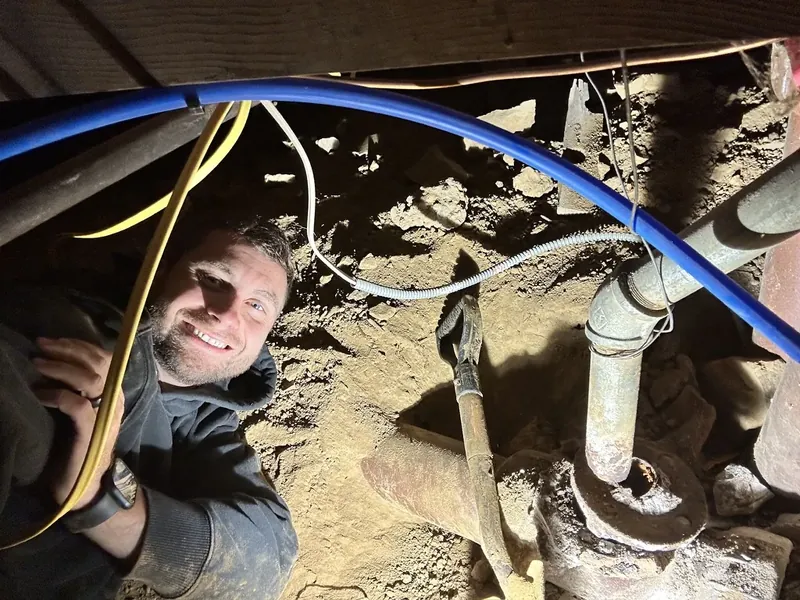
That’s why so much of what we write about here is the part you can’t see — the wiring, the plumbing, the contingency an honest estimate carries.
We’ve also spent years being called in to fix somebody else’s work. It’s honest money and it taught me more than any classroom could. It’s also why we build whole houses — because by the time we’re repairing one, somebody has already decided how good it was going to be.
Same standard, from the footing up.
We bought a distressed 900-square-foot house in Shamokin Dam that had been sitting vacant for years. At the time, we didn’t know whether we’d flip it, rent it or keep it.
We decided to make the things behind the walls right anyway. New electrical. New plumbing. A rebuilt interior, another bedroom, a deck, and eventually the whole property.
Then we decided to stay. My family lives there now.
There’s something different about putting your kids to bed inside walls you built. I know what’s behind that drywall, because I’m the one who put it there — and I live with every decision that got made during construction.
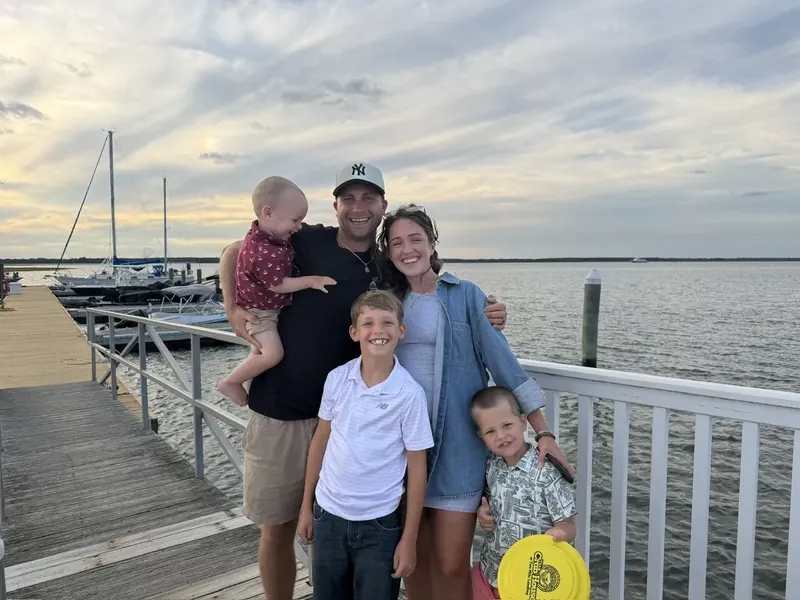
The whole story of that house →
As the company grew, I figured out where I’m most useful.
It isn’t trying to personally be the best electrician, plumber, mason, framer and tile setter on every project.
I want great electricians doing electrical work. Great plumbers doing plumbing. Great framers framing.
My job is making all of those people part of one project.
I spend my time planning, designing, coordinating, solving problems and making decisions. I’m thinking about the site, the layout, the budget, the structure, the trades, the schedule and how all of those pieces are going to come together before somebody starts cutting.
That’s true whether we’re building a new home, putting on an addition or rebuilding an existing one.
The projects are different.
The responsibility isn’t.
There’s a reason I like having my name on the company.
It keeps things personal. If we do something great, my name is attached to it. If something goes wrong, my name is attached to that too.
I’m good with that.
Construction doesn’t always go perfectly. What matters is how you plan, how you communicate, what you do when something unexpected happens, and what you’re willing to put your name on when it’s finished.
Build things you’d be comfortable living in yourself.
I do. I go home to one every night.
How we do the work is just as important as the work we do.
We put the people we work with and for ahead of ourselves. On every job there’s a client, a crew and trade partners counting on us — service means asking what they need right now, especially when it isn’t the easy choice.
We get really good at what we do, surround ourselves with people who are great at the rest, and never stop improving. It isn’t knowing everything. It’s being honest about where you’re excellent and where someone else is.
We steward, respect and multiply what we’re trusted with: time, money, materials and effort. Not just protecting your resources but putting them to work, so they come back as a better result and a home that lasts.
Matthew 25:14–30
We give freely and cheerfully to the people around us — and not just money. Our time, our skill, our patience, credit where it’s due. We look for ways to help, and we give without keeping score.
We set the tone. Every job has problems; we’re the people who say “here’s how we get it done,” not “here’s why we can’t.” Attitude is contagious, and ours is worth catching.
“Hands down by far the best construction / handy man / business owner I have ever had an experience with. Honest, friendly, caring, knowledgeable, and efficient. He went above and beyond from day 1 until completion.”
“This was our first time working with a contractor & our experience was great! Mike and his crew took our project seriously and treated us & our home with respect.”
Fifteen minutes on the phone. You’ll have a realistic range before we hang up — and if we’re not the right people for it, I’ll tell you.